
Blog
All articlesBeget Outage: What Happened, Why Sites Go Down, and How to Build a Resilient Infrastructure
Analyzing the massive Beget outage and showing how businesses can reduce dependency on a single host: backup VPS, independent DNS, S3 backups, and automated deployment.
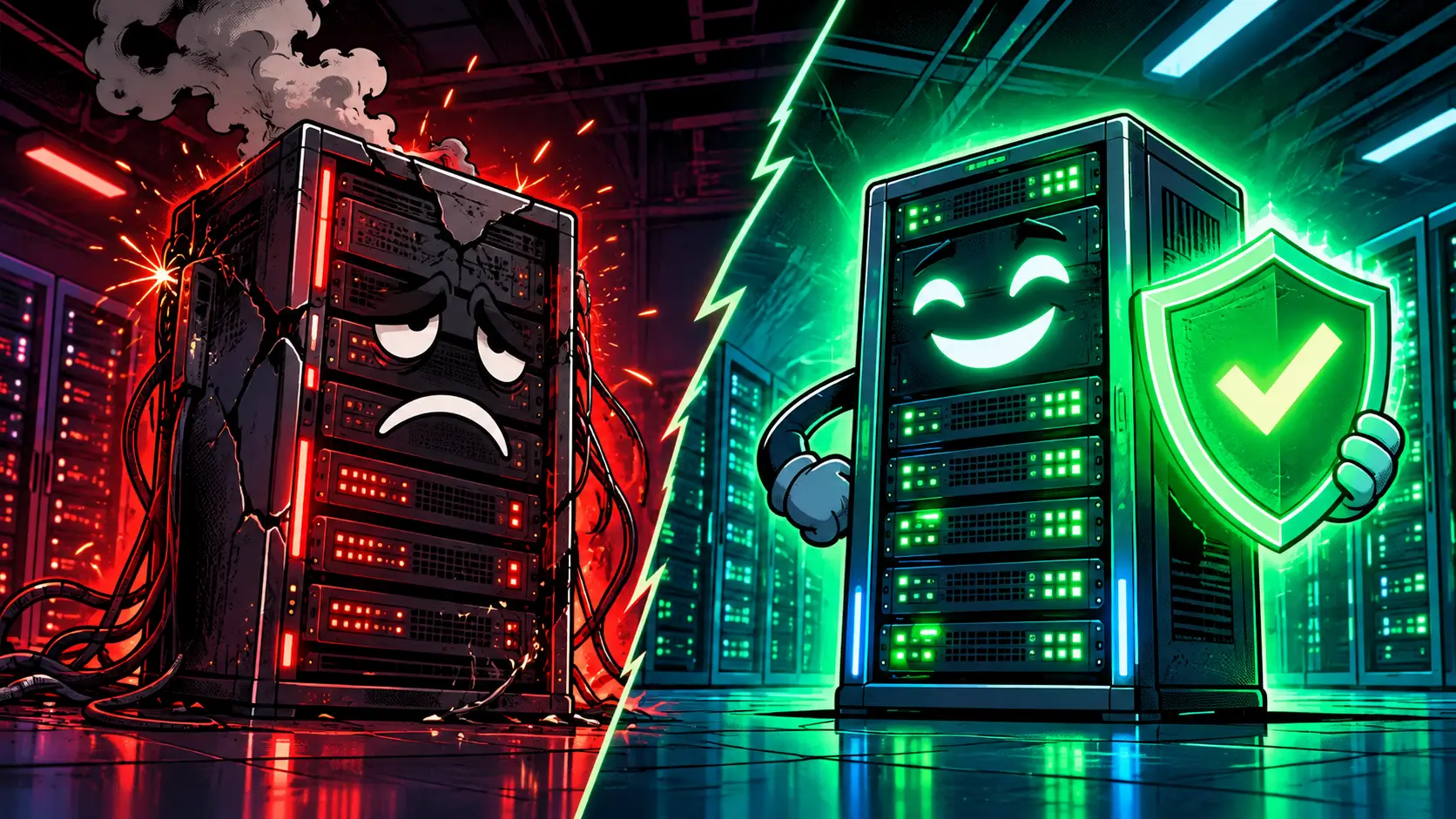
A hosting outage rarely looks like abstract news. For a business, it means halted orders, lost leads, employees without access to the control panel, and clients who cannot open the website. The Beget incident demonstrated this vividly: users in chats and social media discussed massive website unavailability, client area issues, and financial losses from multi-day downtime.
Below is a calm analysis: what happened, what mistakes businesses most often make, and how to reduce dependency on a single provider in the future.
What Happened and Why Beget Sites Went Down
During the attack, the provider's infrastructure experienced a colossal load. Users massively encountered the same picture:
- a Beget site is not opening or returns a
503 Service Unavailableerror; - pages load endlessly;
- Beget S3 storage is unstable, causing images and media files to disappear from websites;
- DNS servers and NS records respond intermittently, so domains temporarily stop resolving;
- the client area and tech support are overloaded, with no accurate ETA for recovery.
It is important to understand: this is not just a "broken website." In such situations, the entire service delivery chain breaks — network, DNS, storage, control panel, and support. If all elements are with one provider, the failure of one layer quickly becomes a failure of the entire business.
If a Beget Site Is Down: What to Do in the First Hours
During an outage, the main thing is not to panic and avoid chaotic decisions.
- Check if the site is down for everyone or just you. Don't panic if the site doesn't load in your browser — the issue might be with your local ISP. Open the site via mobile data or use any free availability checker (like GlobalCheck) to see the status from other networks.
- Accept the reality: without pre-configured backups, emergency migration is impossible. If the server or S3 storage is down right now, and you did not move media files and database dumps to an independent backup S3 in advance while everything was working, you physically cannot migrate anything. In this outage, you just have to wait for the provider to recover. This is a tough lesson for the future: resilience and independent backups must be planned before disaster strikes.
- Record the facts. Start time, errors, monitoring statuses, support correspondence — this will be useful for post-mortem analysis and client communication, as well as for potential compensation.
- Prepare a Plan B for the future. If your website generates revenue, you must have a backup server, backup DNS, and a clear action runbook for the next outage.
Why Hosting Support Doesn't Always Keep Up
During peak outages, any provider's tech support is overwhelmed. This doesn't mean it's not working, but during a massive failure, you cannot count on an instant personal response.
For a business, this means one simple thing: hosting support is not your only response channel. You need your own sysadmin, DevOps contractor, or IT studio that has pre-defined actions for failures and can spin up the site on a backup platform.
The Main Mistake: Keeping Everything in One Infrastructure
The classic mistake is thinking that a VPS solves the resilience problem. A Beget VPS, S3 storage, and the control panel are still within the same provider ecosystem. If the network, DNS, or client area goes down, you lose control over all assets at once.
Many also confuse security with resilience. Properly configured Beget SSH access (e.g., using key authentication and disabling password login) is an excellent tool to protect against hacking and unauthorized third-party access to your server. But SSH is about security, not availability. If the server is physically down or the provider's network fails, SSH won't save you: there is simply nowhere to connect. That is exactly the situation Beget clients faced.
Therefore, resilience is not about a "more powerful VPS," but an architecture with independent platforms, DNS, and backups.
How to Reduce Dependency on a Single Provider
A fault-tolerant architecture depends on the budget and business objectives. It is indeed more expensive than classic hosting. But if a few days of downtime halts sales, investments in redundancy pay off quickly.
1. Code in Git and Deployment via Docker
If the code is stored in a Git repository and the project runs in Docker containers, the website can be deployed on a backup server with another provider in hours, not days. During an outage, you don't wait for Beget to recover — you spin up the project on an alternative platform.
At the same time, you eliminate the dependency on manually uploading website code to Beget via the panel or FTP: deployment becomes reproducible and automated.
2. Independent Backups and S3 Mirroring
To avoid being held hostage by a provider, if you use Beget S3 storage, set up bucket mirroring to an alternative platform — for example, Yandex Cloud or VK Cloud. A good practice is to automatically send database dumps to multiple independent storages at once.
Then, even if S3 is completely unavailable, you still have up-to-date backups on another platform.
3. Secondary DNS and Backup Domains
DNS servers and NS records are a critical point of failure. If the primary zone is unavailable, the website won't open even via a direct link.
Best practice: maintain a Secondary DNS with an independent provider, such as Cloudflare. Additionally, you can set up a backup domain and redirects: if the primary domain or host is unavailable, traffic switches to the backup platform.
4. Backup VPS with Another Provider
Do not keep all production servers in one place. A backup VPS with another provider is not a luxury, but insurance. In case of failure, you switch DNS and spin up a website mirror on the backup server.
5. Independent Monitoring and a Clear Runbook
Monitoring should check the website from the outside, not just "ping the server" from within the same infrastructure. For example, we deploy Grafana on a third-party server with an independent provider. It objectively polls your website and sends alerts (e.g., to Telegram) if it goes down. Such monitoring does not die with your hosting and gives you time to react.
This is complemented by a runbook — a short regulation: who does what, where to switch DNS, where to get the backup, and how to inform clients about the recovery status.
Timeweb or Beget: What to Look for When Choosing?
Many are currently asking: Timeweb or Beget — which is better and more reliable? If you are comparing these providers, we advise you to carefully study independent forums before paying. Despite attractive prices, Timeweb has a rather controversial reputation. Users massively complain about sudden network drops (when websites stop opening on specific devices, such as iPhones), as well as regular mass blockings by Roskomnadzor (RKN), which could affect your project.
But even if you find the perfect provider, outages happen to everyone (as the Beget incident showed). Choosing a single hosting does not solve the single point of failure problem. For a simple business card website, the difference may not be critical, but for a business where the website generates revenue, what matters more is not "who is better," but whether you have a backup platform, independent DNS, and backups.
One provider is a gamble. A reliable architecture for a critical service is built on multiple platforms and automation.
Conclusion
The Beget outage is a good reason to review your architecture, rather than just wait for recovery. If your website makes money, it must have: code in Git, automated deployment, independent backups, secondary DNS, and a backup VPS with another provider.
Have you outgrown regular hosting?
Our IT studio will design a fault-tolerant Highload system for your budget, set up independent backups, backup platforms, and take your IT infrastructure under 24/7 monitoring. Contact us on Telegram or Max to discuss an audit of your current architecture and protection against sudden failures.
Build an estimate or message us — we'll discuss the task.
Webzella services
Read also
 Telegram Mini Apps (Web App): What It Is and How It Differs from BotsWe explain what Telegram Mini Apps are, how they differ from classic bots, how to integrate AI, and why constructors are not suitable for complex businesses.
 Critical PHP Vulnerabilities 2026: How to Patch and Protect Your SiteTwo critical RCE vulnerabilities were found in PHP (CVE-2026-109618 and CVE-2026-109619). We explain how to patch PHP, why updating the CMS is not enough, and why React + FastAPI is safer.
 What is an IT System and Why Your Business Needs ItMany confuse an IT system with a regular website. In fact, it is a complex software solution that automates business processes. We explain what it is, why it is needed, and how not to waste money.